The course focuses on resilience, mental health and wellbeing in everyday youth work. Participants will learn how to listen actively, ask supportive questions, recognise stress and emotional overload, create psychologically safe spaces and maintain appropriate professional boundaries.
The programme combines discussion, peer learning, reflection, role-play, case work and practical activity development. Participants will design and test their own methods and jointly create a Resilient Youth Work Toolkit that they can use in their organisations.
| Monday 19 October |
Arrival, accommodation, introduction to the training course and getting to know each other Evening Welcome dinner |
| Tuesday 20 October |
Morning Understanding resilience, mental health and wellbeing Afternoon The Hand of Mental Health; exploring what makes young people resilient; reflection |
| Wednesday 21 October |
Morning Active listening and listening without immediately trying to solve problems Afternoon Supportive dialogue, open questions and practical role-play |
| Thursday 22 October |
Morning Recognising stress, emotions and overload; “Mental Salad” activity Afternoon Exploring Magdeburg Evening Intercultural sharing |
| Friday 23 October |
Morning Supporting young people without becoming a therapist; boundaries, responsibility and referral Afternoon Psychological safety, inclusive youth work and the Resilience Lab case challenge |
| Saturday 24 October |
Morning What builds resilience in youth work? Activity design laboratory Afternoon Developing resilience and mental-health activities and testing them with other groups |
| Sunday 25 October |
Morning Creating the Resilient Youth Work Toolkit and planning practical transfer Afternoon Evaluation, Youthpass and preparation for departure Evening Final celebration |
| Monday 26 October |
Departure of participants |
Travel expenses will be reimbursed based on Erasmus+ rules, up to a certain limit.
The Erasmus+ Programme Guide for 2024 has updated the reimbursement rates for travel costs based on distance, and the new values are as follows:
| Distance | Green Travel (€) / person | Non-Green Travel (€) / person |
|---|---|---|
| 10–99 km: | €56 | €28 |
| 100–499 km: | €285 | €211 |
| 500–1,999 km: | €417 | €309 |
| 2,000–2,999 km: | €535 | €395 |
| 3,000–3,999 km: | €785 | €580 |
| 4,000–7,999 km: | €1,188 (both green and non-green travel) | |
| 8,000 km or more: | €1,735 (both green and non-green travel) | |
You can get an estimate of the distance that applies to you with the Erasmus+ Distance Calculator.
Green Travel: Travel that use low-emissions means of transport for the main part of the travel, such as bus, train, bike or car-pooling. Please check the Eramus+ Programme Guide for further information.

International training courses in the international educational and youth work field offer diverse opportunities for educators, youth workers and volunteers to enhance their skills and knowledge on a global scale. These courses typically cover pedagogical techniques, curriculum development, and educational technology, fostering a cross-cultural perspective.
Participants engage in collaborative learning, gaining insights into varied teaching methodologies, youth engagement strategies, and cultural nuances. Ultimately, these programs equip educators and youth workers with the tools to create more inclusive and effective learning environments and youth development initiatives.
The EJBM regularly offers various international training courses in Magdeburg with different topics and learning objectives.
EJBM training courses are primarily aimed at professionals who are currently actively involved in youth work. Volunteers in the field are also invited to attend. If there are more applications than places available, a pre-selection procedure will take place.
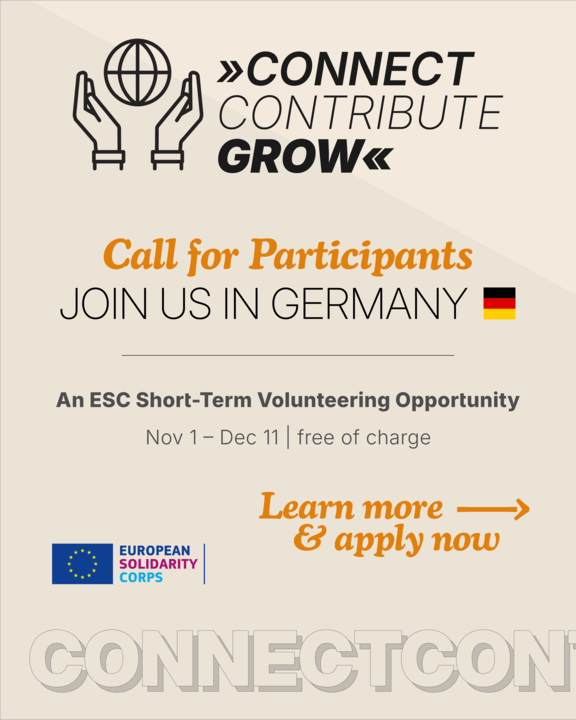
Join an ESC team of up to 15 international volunteers and become part of the everyday life of the European Youth Education Centre Magdeburg (EJBM). This project gives you the opportunity to explore different areas of our work and gain practical experience through a variety of tasks.
During your stay at EJBM, you will have the opportunity to support different areas of our youth centre and become an active part of its everyday life. Your tasks will be varied and will combine practical, organisational and educational activities. With guidance from our staff, you may help prepare meals, support the service team, assist with small repairs and maintenance, or take part in minor construction and hands-on tasks around the centre.
At the same time, you will contribute to the educational and social activities taking place at EJBM. This may include helping with our annual Christmas market, providing language animations and activities for groups of children visiting the youth centre, and supporting programmes and events during your stay in Magdeburg.
The project is about versatility, learning by doing and bringing different elements of our work together. It offers you the chance to gain hands-on experience, develop practical life and workplace skills, discover your strengths and become more confident in taking responsibility and working as part of a team.
Travel expenses will be reimbursed based on Erasmus+ rules, up to a certain limit.
The Erasmus+ Programme Guide for 2024 has updated the reimbursement rates for travel costs based on distance, and the new values are as follows:
| Distance | Green Travel (€) / person | Non-Green Travel (€) / person |
|---|---|---|
| 10–99 km: | €56 | €28 |
| 100–499 km: | €285 | €211 |
| 500–1,999 km: | €417 | €309 |
| 2,000–2,999 km: | €535 | €395 |
| 3,000–3,999 km: | €785 | €580 |
| 4,000–7,999 km: | €1,188 (both green and non-green travel) | |
| 8,000 km or more: | €1,735 (both green and non-green travel) | |
You can get an estimate of the distance that applies to you with the Erasmus+ Distance Calculator.
Green Travel: Travel that use low-emissions means of transport for the main part of the travel, such as bus, train, bike or car-pooling. Please check the Eramus+ Programme Guide for further information.
The European Solidarity Corps (ESC) is an amazing opportunity for young people who want to travel abroad and make a positive impact on communities and society. It's a program run by the European Union that gives young people between the ages of 18 and 30 the chance to volunteer or work on projects that make a real difference in the world.
Whether you want to help others, learn new skills or gain valuable experience, our ESC projects have something for everyone. With a wide range of projects available, you can choose to work on something that matches your passions and interests. From helping the elderly and disabled to protecting the environment and promoting cultural diversity, the possibilities are endless.
Not only will you make a meaningful contribution to society, but you'll also develop new skills, make new friends and broaden your horizons. You'll have the opportunity to learn from other cultures, build your network, and gain experiences that will last a lifetime.
So if you're looking for a way to make a positive impact, grow as a person, and have the time of your life, an ESC project at EJBM is the perfect opportunity for you! Apply now and start your journey towards a more fulfilling and meaningful future.
ESC Official Website ESC Official FAQThe button below will take you to this volunteering opportunity on the European Youth Portal. We can only consider applications that you submit there.
Sorry, Anmeldungen sind nicht mehr möglich.
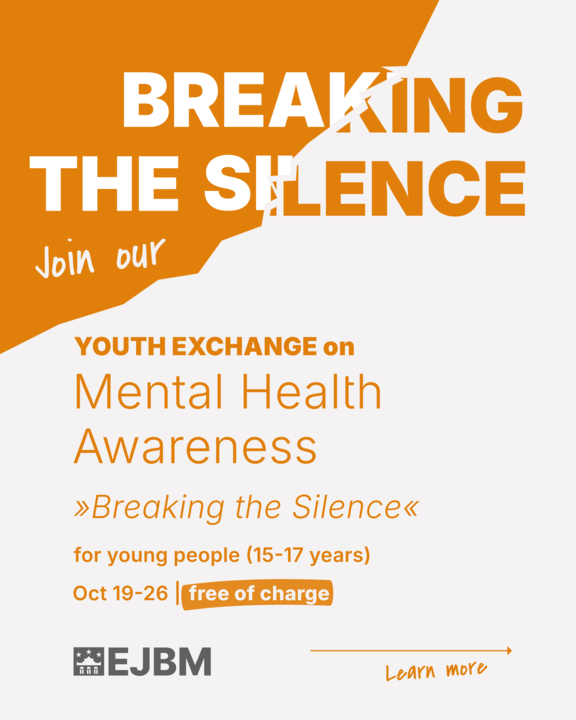
This international youth exchange focuses on mental health, stress management, resilience and peer support. You will explore what mental well-being means in everyday life, reflect on your own needs and experiences, and discover practical strategies for coping with stress. The project also aims to strengthen your self-confidence, social skills and ability to support others.
Creative workshops, group discussions and guided reflection exercises will help you approach the topic from different perspectives. Language animation, peer-support activities, outdoor exercises and team-building activities will encourage cooperation and intercultural exchange. You will also have opportunities to share experiences with young people from other countries and develop ideas for promoting mental health awareness in your community.
The programme will be complemented by relaxed evening activities and an intercultural evening. Further details about the daily programme will be announced later.
The youth exchange is aimed at young people aged 15 to 17 who are interested in mental health and willing to learn and participate actively.
Participants should be able to communicate in English at a conversational level. Perfect grammar or advanced language skills are not required. No previous experience or specialist knowledge is needed.
Travel expenses will be reimbursed based on Erasmus+ rules, up to a certain limit.
The Erasmus+ Programme Guide for 2024 has updated the reimbursement rates for travel costs based on distance, and the new values are as follows:
| Distance | Green Travel (€) / person | Non-Green Travel (€) / person |
|---|---|---|
| 10–99 km: | €56 | €28 |
| 100–499 km: | €285 | €211 |
| 500–1,999 km: | €417 | €309 |
| 2,000–2,999 km: | €535 | €395 |
| 3,000–3,999 km: | €785 | €580 |
| 4,000–7,999 km: | €1,188 (both green and non-green travel) | |
| 8,000 km or more: | €1,735 (both green and non-green travel) | |
You can get an estimate of the distance that applies to you with the Erasmus+ Distance Calculator.
Green Travel: Travel that use low-emissions means of transport for the main part of the travel, such as bus, train, bike or car-pooling. Please check the Eramus+ Programme Guide for further information.
Sorry, Anmeldungen sind nicht mehr möglich.
Youth exchanges are dynamic programs that bring together young people from different countries to share experiences, ideas, and cultures. Through these exchanges, participants engage in various activities, workshops, and projects that promote cross-cultural understanding, personal growth, and the development of essential life skills.
By fostering international friendships and collaboration, youth exchanges inspire a sense of unity, open-mindedness, and european/global citizenship among the next generation, preparing them to be active contributors to a diverse and interconnected world.
The EJBM regularly offers various international youth exchanges in Magdeburg with different topics and learning objectives.
Youth Exchanges at EJBM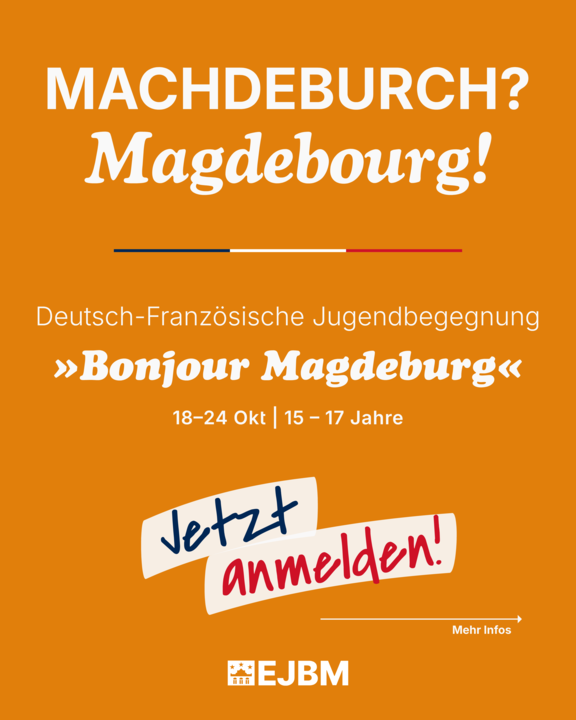
Im Mittelpunkt stehen deutsch-französische Geschichte und französische Spuren in Magdeburg. Ausgangspunkt ist das DFJW-Projekt „63 Orte deutsch-französischer Geschichte“ mit der digitalen Plattform Cartorik. Sachsen-Anhalt weist vielfältige historische Verbindungen zu Frankreich auf, ist auf der Plattform bislang jedoch nicht mit einem Ort vertreten. Die Jugendlichen untersuchen deshalb, wo ihnen Frankreich in Magdeburg begegnet und welche Geschichten diese Orte erzählen.
In deutsch-französischen Kleingruppen recherchieren die Teilnehmenden historische Quellen, erkunden ausgewählte Orte und beschäftigen sich mit Migration, religiöser Vielfalt, Flucht, kulturellem Austausch und Erinnerungskultur. Workshops, Exkursionen und Gespräche mit lokalen Fachleuten vermitteln Methoden der historischen Recherche und Medienarbeit.
Die Ergebnisse werden kreativ aufbereitet, beispielsweise als Kurzvideos, Podcasts, digitale Karten oder Fotostorys. Daraus entstehen Vorschläge für neue deutsch-französische Erinnerungsorte, die für eine mögliche Einreichung bei Cartorik vorbereitet werden. Sprachanimation, Reflexionsrunden und gemeinsame Freizeitaktivitäten fördern den Austausch und die Zusammenarbeit in der Gruppe.
Die Begegnung richtet sich an 15- bis 17-jährige Jugendliche aus Deutschland und Frankreich. Vorkenntnisse zur deutsch-französischen Geschichte oder Erfahrung mit Medienprojekten sind nicht erforderlich. Minimale Französischkenntnisse genügen. Deutsch und Französisch werden als Arbeitssprachen genutzt; Sprachmittlung und Sprachanimation unterstützen die Verständigung.
Das Angebot passt besonders zu dir, wenn du andere Jugendliche kennenlernen, Magdeburg aus einer neuen Perspektive entdecken und Geschichte kreativ vermitteln möchtest.
|
Sonntag 18. Oktober |
Anreise der Gruppen und Check-in in der EJBM Begrüßung, Kennenlernen und Sprachanimation Vorstellung von „Bonjour Magdeburg!“ und „63 Orte deutsch-französischer Geschichte“ Interkultureller Abend und Teamspiele |
|
Montag 19. Oktober |
Sprachanimation Workshop zu deutsch-französischer Geschichte, den Hugenotten und weiteren französischen Spuren in Magdeburg Stadtführung „Auf den Spuren Frankreichs in Magdeburg“ Deutsch-französisches Escape Game |
|
Dienstag 20. Oktober |
Sprachanimation und Rechercheworkshop zu Quellen, Karten, Cartorik und Arbeitsmethoden Exkursion zu ausgewählten historischen Orten Gespräche mit lokalen Expert*innen aus Museum, Stadtarchiv oder Verein Silent Disco |
|
Mittwoch 21. Oktober |
Sprachanimation und Fortsetzung der Projektarbeit Gemeinsame Reflexion Spieleabend |
|
Donnerstag 22. Oktober |
Sprachanimation Kreativwerkstätten: Kurzvideos, Podcasts, digitale Karten oder Fotostorys gestalten Vorschläge für neue Cartorik-Orte erarbeiten Filmabend |
|
Freitag 23. Oktober |
Sprachanimation und Fertigstellung der Projektarbeiten Präsentation der Ergebnisse und Diskussion der Vorschläge für Cartorik Gemeinsame Reflexion und Spieleabend |
|
Samstag 24. Oktober |
Sprachanimation und Abschlusseinheit „Was nehmen wir mit?“ Feedback, Evaluation und Youthpass-Reflexion Abschlussabend mit Zertifikatsübergabe Abreise der Gruppen |
Travel expenses will be reimbursed based on Erasmus+ rules, up to a certain limit.
The Erasmus+ Programme Guide for 2024 has updated the reimbursement rates for travel costs based on distance, and the new values are as follows:
| Distance | Green Travel (€) / person | Non-Green Travel (€) / person |
|---|---|---|
| 10–99 km: | €56 | €28 |
| 100–499 km: | €285 | €211 |
| 500–1,999 km: | €417 | €309 |
| 2,000–2,999 km: | €535 | €395 |
| 3,000–3,999 km: | €785 | €580 |
| 4,000–7,999 km: | €1,188 (both green and non-green travel) | |
| 8,000 km or more: | €1,735 (both green and non-green travel) | |
You can get an estimate of the distance that applies to you with the Erasmus+ Distance Calculator.
Green Travel: Travel that use low-emissions means of transport for the main part of the travel, such as bus, train, bike or car-pooling. Please check the Eramus+ Programme Guide for further information.
Youth exchanges are dynamic programs that bring together young people from different countries to share experiences, ideas, and cultures. Through these exchanges, participants engage in various activities, workshops, and projects that promote cross-cultural understanding, personal growth, and the development of essential life skills.
By fostering international friendships and collaboration, youth exchanges inspire a sense of unity, open-mindedness, and european/global citizenship among the next generation, preparing them to be active contributors to a diverse and interconnected world.
The EJBM regularly offers various international youth exchanges in Magdeburg with different topics and learning objectives.
Youth Exchanges at EJBM
Der deutsch-französische Study Visit beschäftigt sich mit der Frage, wie Jugendarbeit, Sport und Kultur zur Förderung gesellschaftlichen Engagements, demokratischer Teilhabe und zur Bekämpfung von Rassismus und Ausgrenzung beitragen können. Fachkräfte aus Jugendarbeit, Bildung, Soziokultur und Sport erhalten Einblicke in unterschiedliche Einrichtungen und Praxisansätze in Bourges und Umgebung. Ziel ist es, inspirierende Projekte kennenzulernen, Erfahrungen und Methoden aus der beruflichen Praxis miteinander zu vergleichen und neue Impulse für die eigene Arbeit zu gewinnen. Gleichzeitig sollen interkulturelle Kompetenzen gestärkt, deutsch-französische Partnerschaften ausgebaut und Perspektiven für zukünftige gemeinsame europäische Projekte entwickelt werden.
Methodisch verbindet der Study Visit Praxisbesuche, Fachinputs, Workshops, Begegnungen und kollegialen Austausch. Auf dem Programm stehen unter anderem ein Workshop zur Bekämpfung von Gewalt, Besuche bei Einrichtungen der Jugendinformation und Jugendarbeit, Einblicke in Programme zur beruflichen und sozialen Integration durch Sport sowie ein Austausch über internationale Projekte. Ergänzt wird das Programm durch einen Vortrag zu den Werten des Olympismus und zur Mobilisierung von Akteur*innen im Sport sowie durch die Begegnung mit einem paralympischen Sportler zu Fragen von Lebensweg und Barrierefreiheit. Regelmäßige Sprachanimationen, interkulturelle Aktivitäten und eine gemeinsame Abschlussauswertung unterstützen den deutsch-französischen Austausch und die Reflexion des Gelernten.
|
Sonntag 11. Oktober |
Anreise |
|
Montag 12. Oktober |
Vormittag Sprachanimation, Vorstellung des Aufenthalts mit Zielen und Erwartungen sowie Besichtigung des CREPS Nachmittag Workshop zur Bekämpfung von Gewalt mit Guillaume Pichard (CREPS) Abend Interkultureller Abend |
|
Dienstag 13. Oktober |
Vormittag Sprachanimation sowie Besuche im Jugend- und Informationszentrum und im Europäischen Jugendzentrum Nachmittag Besichtigung von B28 und Austausch mit den Leitungen Abend Abendessen mit den Partnerorganisationen |
|
Mittwoch 14. Oktober |
Vormittag Sprachanimation sowie Besuche bei Ufolep du Cher zu Programmen der beruflichen und sozialen Integration durch Sport und bei der Ligue de l’Enseignement du Cher zu internationalen Projekten Nachmittag Besuch des Wohnheims für junge Berufstätige in Saint-Amand-Montrond Abend Interkultureller Abend |
|
Donnerstag 15. Oktober |
Vormittag Sprachanimation und Vortrag des CROS zu den Werten des Olympismus, zur Mobilisierung der Akteure im Sport sowie zu Methoden und Werkzeugen Nachmittag Begegnung mit einem paralympischen Sportler: Lebensweg und Barrierefreiheit für Menschen mit Behinderung Abend Evaluation |
|
Freitag 16. Oktober |
Abreise |
Reisekosten werden vollständig getragen. Es fallen keine Kosten für Teilnehmende an.
International training courses in the international educational and youth work field offer diverse opportunities for educators, youth workers and volunteers to enhance their skills and knowledge on a global scale. These courses typically cover pedagogical techniques, curriculum development, and educational technology, fostering a cross-cultural perspective.
Participants engage in collaborative learning, gaining insights into varied teaching methodologies, youth engagement strategies, and cultural nuances. Ultimately, these programs equip educators and youth workers with the tools to create more inclusive and effective learning environments and youth development initiatives.
The EJBM regularly offers various international training courses in Magdeburg with different topics and learning objectives.
EJBM training courses are primarily aimed at professionals who are currently actively involved in youth work. Volunteers in the field are also invited to attend. If there are more applications than places available, a pre-selection procedure will take place.

Europäische Jugendbildungsstätte Magdeburg
bei der Bildungsnetzwerk Magdeburg gGmbH
Lüttgen-Ottersleben 18a
39116 Magdeburg